Thursday, April 7, 2011

2011 Reel Paddling Film Festival

Having been a kayak angler for some time now, I've found a brotherhood of others who share my affection for the sport.  Predictably so.  What I didn't expect is to also find a kinship with other non-fishing kayakers.  Whether it be touring, whitewater, or fishing, whenever I see another kayak in transit, I scope out the ride and nod or wave, kinda like people on motorcycles.  I like to think it's the love of the paddle that carries through the different genres.

So when Wayne Brady reminded me that the 2011 Reel Paddling Film Festival was in Richmond last night, I used up a precious kitchen pass, and had to check it out.  It was at the new Blue Ridge Mountain Sports store which I've been wanting to visit anyway.  I got there a few minutes late, but was told I didn't miss much.  It was fascinating to watch and listen to a whole other world of kayaking.  They have their own insiders language like how us kayak anglers have ours.  My wife likes to roll her eyes and asks me to speak like a normal person when get excited and start using acronyms and other yak fishing terms.  It gets pretty bad if I mix in the local terms too.  "RVA to HRBT, to the CBBT, in my OK trident, stopped at OE2, fiddlers, tried over the tubes, damn toads, need that paper togzilla... got mullet?"  Word up, my homies.

Anyway, I would say my favorite was Kayak Kevin's award winning "Kayak Fishing the Chesapeake Bay", which I make a quick appearance in (had to throw that in there), but having seen it several times already, I wanted to note a few others.

-Book of Legends-


-The Halo Effect-


At one point during the show, Wayne turns to me and says...  "and people think we're crazy!"
Hats off to our brothers of the whitewater.  You all are freakin' nuts.

Check out all the other winners of the 2011 Reel Paddling Film Festival.

Monday, April 4, 2011

Tautog Rig

The Tautog may not be as well sought after as some of the more popular species like founder, striper, trout and reds, but I believe they are catching on.  Their reputation for putting up intense fights are well deserved, so if you decide to give it a shot at these bulldogs of the rocks, here are some of my personal preferences when fishing for them from a kayak.


I like to use a stout yet sensitive 6.5' - 7' rod paired with a quality baitcasting reel with tight but smooth drag.  Shimano Calcutta 200 Series and Daiwa Luna are top notch but others will do as well.  For bait I use either cut blue crab or live whole fiddler crabs.  Green crabs, hermit crabs, clams and other crustaceans also work.

Since togs are structure dwelling, you have to put the bait IN the structure.  There's a saying with tog anglers... if your rig is not getting hung up on structure often, then you're not fishing the right place.  The nastier, the better.  Rocks, wrecks, reefs, and bridge structures are the hot spots.  Since the potential for breaking off rigs is high, I tie several in advance.  I wrap them around a piece of cardboard and put them in a leader wallet so they are quickly accessible.  Instead of wasting time on the water, especially if the bite is on, it's better to be prepared.

When fishing bridge pilings, kayak anglers have an advantage because we can literally grind up next to the structure.  During the slow parts of the tide (top of the incoming and bottom of outgoing) as well as slack tide, we don't even have to anchor up usually.  Just maintain position with one arm paddling and drop your rig right next to the piling.  Usually if there's a little current, you can put your bait in the eddy directly behind the piling (on the back side of the current).  Move the the rig every now and then if you're not getting any bites.  Just a few feet away can make a difference.  As you lift and drop your rig, it will find other holes that the togs may be in.  Same goes for fishing the wrecks and rocks, especially over the tubes of a tunnel.

If current picks up you will need to anchor to keep position.  For local kayak anglers, wreck anchors for kayaks are available at Ocean's East 2 (Virginia Beach).  Kayak Kevin works there so give him a shout and ask about the "piling hugger's" special set up.
For more information about my anchor set ups visit this link.


Finally, togs are a structure dwelling specie that are known to stay in the same area for long periods of time.  I caught a tog last year that was tagged two weeks before, in almost the exact same location.  It's my understanding that they remain on the same piece of structure and since the number of areas that kayaks can fish for tautog are limited, I believe tautog fishing grounds can be fished out.  And once a kayakable area is fished out, it will be a while before it gets re-populated.  And like I mentioned in the beginning, more and more people will be wanting to appreciate the fight these brutes have to offer.  So, I always release all the females as well as any fish over 20".  These are just my personal preferences so take it or leave it as you will.  I do know they are absolutely delicious, but I'd like to be able to fish for them in my kayak for many, many years to come.   I hope you do too.

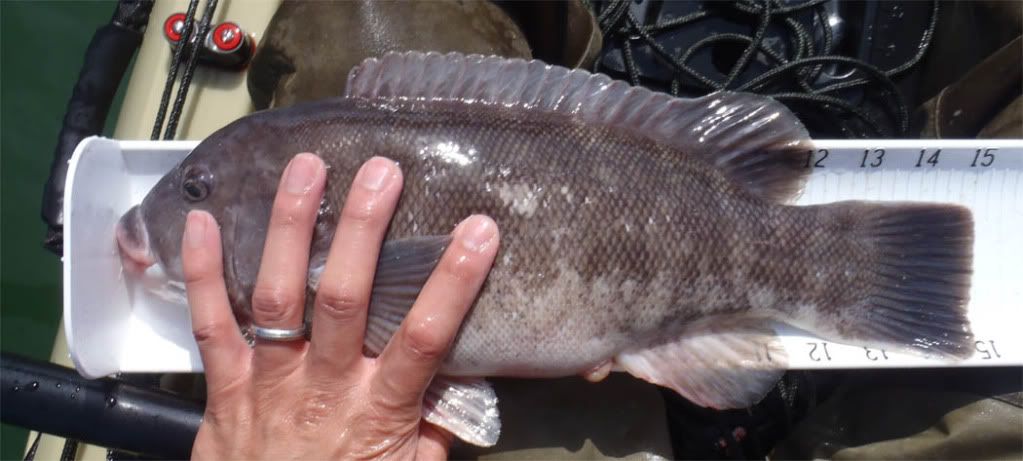
Male Tautog
Lighter gray coloring on top with white on bottom.  Face is usually blunt, sometimes having more of a "chin".
Female Tautog
Darker color all over, sometimes with a pattern.  Nose/face usually comes to a point.
They really are a blast to catch, so get out there, be safe,  
and feel the fight!

Sunday, April 3, 2011

Anchor Setups

The kind of bottom surface you're fishing over will determine what kind of anchor you want to use.  The depth of the water will also play a role in your decision as well.  The following are some personal preferences that I have acquired for the different places I fish. 

If anchoring in sandy or soft bottom then I use a 5.5lb grapple style anchor.  I secure the main anchor rope to the bottom of the anchor and tie 20lb monofilament to the top, holding the rope in place.  That way, if the anchor gets lodge under something, I can lift up on the rope, break the monofilament and bring the anchor up by the bottom.  Otherwise it would be impossible to dislodge the anchor.


I also cut the rope and tied on a heavy duty swivel so I can detach the rope easily if I want to switch out anchors.  Also, the swivel helps reduce rope twists since the anchor likes to spin when pulling it up through the water.

My main is 100 feet since there are times I anchor fairly deep (30'-50').   I attached a heavy duty off-shore swivel/clip to easily attach the right anchor for the situation.


There are other styles of anchors that work well (ie: bruce anchors), but I have not tried them yet since the grapple style has worked well for me.


I also have a small grapple style anchor that I use more to drag.  It helps slow down my drift if current and/or wind are pushing my kayak too fast through the target area.


If I'm on a flat where it's less than 4 feet deep, I'll bring my stake-out pole instead of an anchor.  I won one made by Hobie in last year's TKAA tourney.  It's easier to handle.  No rope.  Just put it through your anchor trolley and stick it in the ground.  Done deal.
If anchoring in rocks or an area with a lot of structure, I use a mini wreck anchor.  Instead of rebar, like on the large wreck anchor for big boats, these have thin flexible stainless steel rods.  For those that are in the Tidewater, VA area, they are available at Ocean's East 2.  The guy that introduced me to these awesome anchors works there.  Ask Kayak Kevin about the "piling huggers" special set up.


They may look small and perhaps too thin to hold in fast current, but I was very surprised to find that they held well and they were very easy to recover also.


I like to have my rope coiled under my leg so it's easy to disperse.  I used to keep it wrapped around something but it took up room, became cumbersome, and this was just easier.  When I recover the anchor, the rope ends up in a coil there anyway.


I always send my anchor rope to one end of the kayak or the other.  I rarely anchor up to the side.  It can quickly become disastrous in fast current.  Also I like to attach a buoy (piece of a fat pool noodle) outside the anchor trolley clip, so just in case I need to release my anchor line because of emergency or to chase an epic fish, it's quick and easy.  For more information about how I rigged my anchor trolley and cleats visit this link.

I hope this helps.

Tight lines and be safe!

Tuesday, March 29, 2011

More Shad and a Flathead

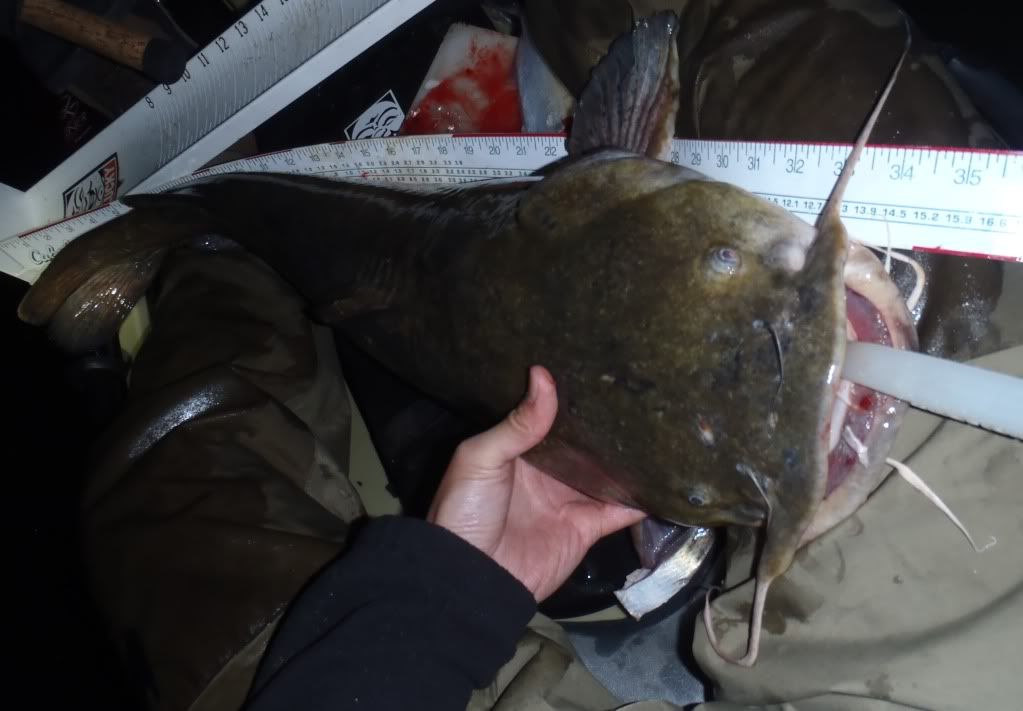
Since I couldn't get to the salt, I stayed in Richmond and played with the shad.  The action is getting better and in a week or two it'll be hot (and the boat traffic will be chaotic).  I kept a few and chunked them up for the kitties.  Just before I packed it in for the night I was delighted to find this guy munching on the end of my line...

Monday, March 28, 2011

The Versatile Garden Sprayer - "Gear" Review


If you fish from a kayak, then your gear is going to get wet.  It's just the way it is.
The mere fact that we are just inches above the water makes it near impossible for our gear not to get wet.  Whether it's simply the drip from your paddle, to your hands, on to your reel, or from the splash and/or handling of a fish, to even dunking your reel by accident.... it is inevitable.  And if you fish the salt, like I do, it is of the utmost importance that you rinse your gear promptly after you get off the water.  Through the years I have ruined more equipment than I care to admit by failing to do just that.  It could have been just laziness or simply just fatigue from paddling/fishing all day, regardless it was getting expensive.  As I accumulated nicer equipment, I realized that no matter how awesome the rods and reels were, if I didn't maintain them, they would turn to crap just like my old stuff. 


Upon accepting this simple nature of the game I kept about a dozen used water bottles in my car filled with tap water so I can pour it on my gear while packing up the car at the end of a trip.  I didn't want to wait until I got home because sometimes it would take quite a while before I got back or I might not be headed straight home.  After using the bottles for most of last year, I got tired of empty ones rattling around in my car, not to mention having to refill them all constantly.  So when the light bulb came on I was like "Duh, why didn't I think of this sooner?"

I've been using a garden sprayer for several months now and it's getting the job done well.  I found a small one gallon sprayer at the hardware store for around $10.  I don't have to fill it up as often since I'm able to focus the spray on exactly where I want instead of dumping water all over.  Also, it doesn't take up too much room in my little hatchback.  I don't even take it out unless I have to fill it up.  It stays bungie tied inside and all I have to do is pump a few times for pressurized fresh water.  The adjustable nozzle is great for my rods, reels, radio, various tools... anything sensitive to rust or corrosion.  It even comes in handy to wash off sand on your shoes, feet, hands, sunglasses, whatever.   I will still take apart, clean, oil and lube my reels once or twice a year, but in the mean time my garden sprayer will help.


Saturday, March 26, 2011

There's Magic in the Air


The dogwoods are blooming, the water temps are rising, the fresh grass is of a color that makes my eyes happy...   there's magic in the air.

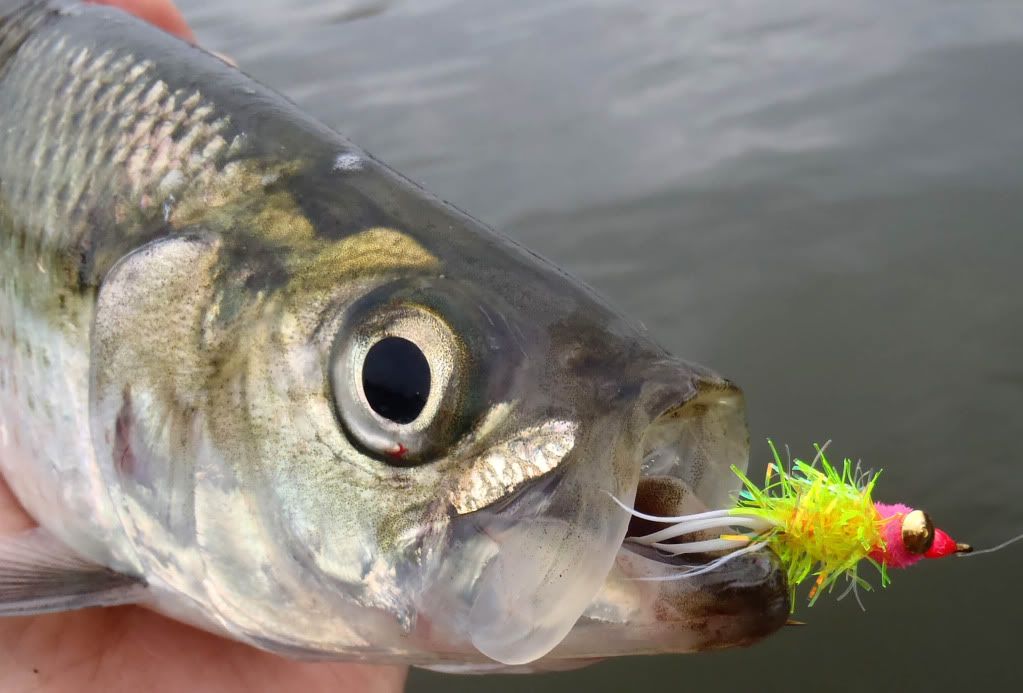
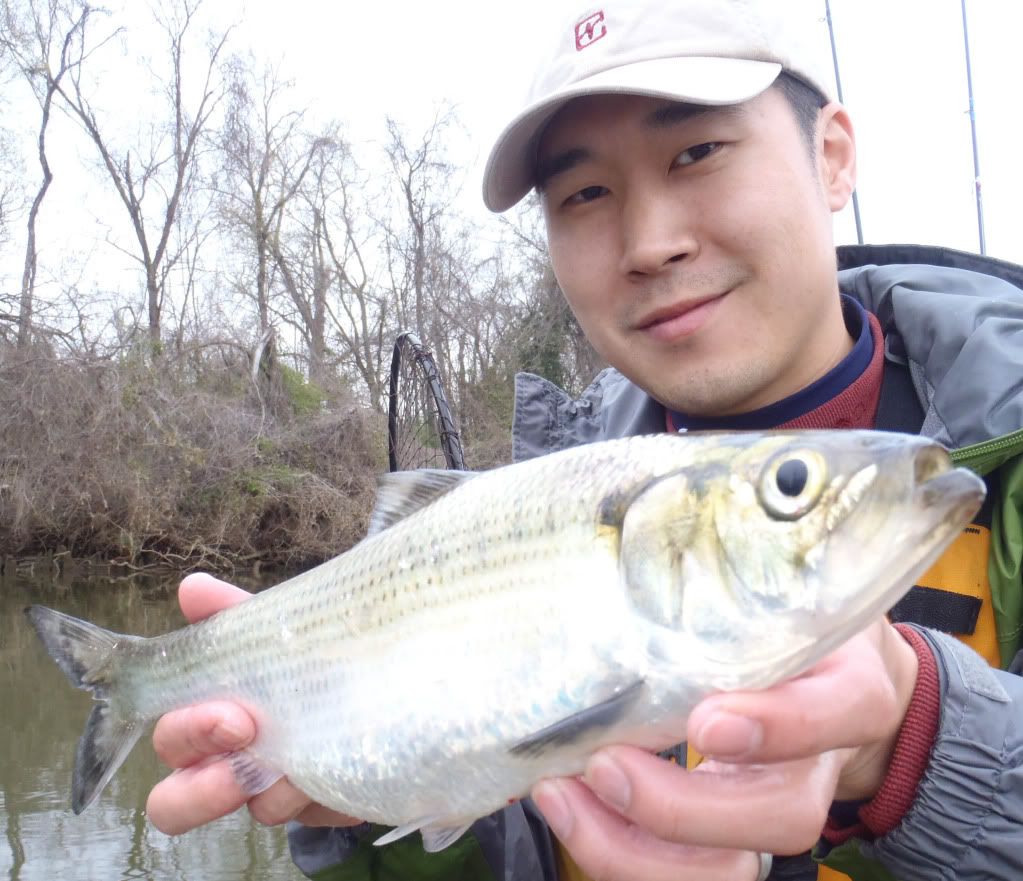
The "poor man's tarpon" have arrived in my neck of the woods and the excitement in the local anglers is evident.  The annual shad run is really quite amazing and I look forward to it every year.  It is a mere 5 minute drive from my yard to where the James River bends it's way through downtown Richmond.  So when I was given a few hours to do what I want to do, the choice was simple.  I dusted off the flyrod, loaded the yak and got on the water.  I got to one of my favorite spots and quickly hooked up to a nice hickory shad.  They fight well for a relatively small fish.  Not giving up easily, they pull fly line from my fingers, making it difficult not to smile.

But that's not the best part.

Next, thing you know, they fly out of the water, violently shaking their heads, just like mini-tarpon.

Not just once, but some jump several times... all shiny, glimmering, beautiful....

like I said....

there's magic in the air.


Monday, March 21, 2011

Kiss the Tog

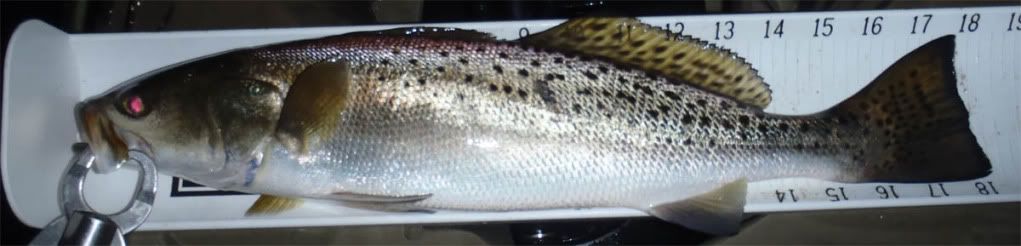
After last week's recon mission and failure to capture the mighty Tog, it became imperative that I make another assault.  With the need for tog-pullage now at code red, I was granted permission by my superior (the Mrs.) to search and redeem myself.  Operation "Kiss the Tog" was a go.  I transported my vessel to Virginia Beach from my home base in Richmond late Saturday afternoon and upon arrival at the local intelligence center and supply depot, Oceans East 2, I stocked up on a deadly arsenal of fiddlers & bluecrabs in preparation for my strike in the morning.  I was also able to acquire valuable reconnaissance from a few highly decorated officers.  Afterwards I was briefed at a POL meeting about future missions and subsequently invited to participate in a side raid to the infamous Hot Ditch.  The time was 2030, and with launch time for Operation Kiss the Tog being 0700 I had time to kill.  I accepted the invitation with hopes of capturing the ever elusive speckled trout.  Dan Smullen and I launched and met up with speckled trout guru, Tim Morris.  With "Specks" as his moniker, he proved his namesake having already captured a 23.75" trout before we even got there.  However, the action had slowed significantly and by 0200 I had only one trout to show.

Dan had one at 19" and Specks got a 32" Striper surprise.  

I was awakened at 0600 by the howling of the wind and violent swinging of the trees.  I urgently checked the forecast and the previous predictions of 8-12kts turned into 20kts with gusts to 25kts.  DAMN YOU NOAA!  I retreated back to Ocean's East to vent my frustrations and hopefully devise another plan of attack.  Kiptopeke was suggested since the concrete ships are known to hold small togs, however, while continuously checking the weather, I noticed the forecast called for diminishing winds later in the morning and afternoon.  By 0930 the 20kts came down to 14kts and I decided it was time.  At 1030 I launched my kayak and accepted the 3 mile punishment I was about to endure for that chance to fight the togs. 
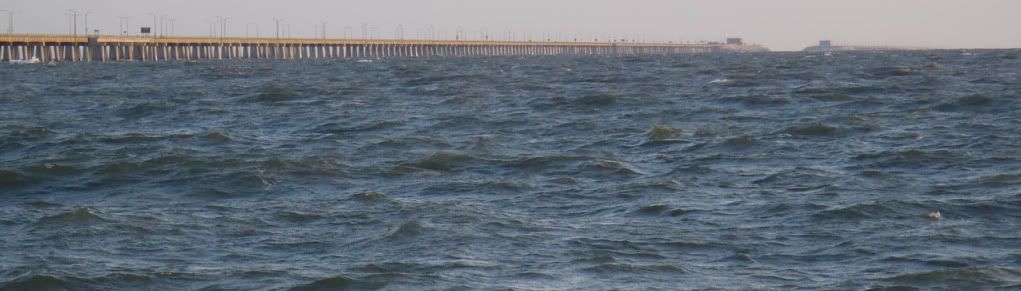


It took me almost and hour and half, but I got there in good spirits, optimistic and focused on the mission.  With the incoming tide almost done, I deployed my blue crab on a dropper loop with 4oz of lead and felt it infiltrate the rocky hold out of the togs.  It took a little while to find the right place, but once I did, I felt that quick tap, followed by another tap, and I jolted my rod up.... but my rig was already disarmed by the skilled blackfish.  It took me 5 or 6 times of getting picked off before I was able to hook one up.  And as soon as I did, I was grinning ear to ear.  It fought hard.  Hard enough for me to think it was going to be bigger than 15". 

Over the next several hours I did battle with about a dozen strong togs with the biggest going 20".  That fight from the 20"er is what I came for.  All that traveling, prepping, paddling in the wind was worth it to fight that fish.

Mission Accomplished!
Justin Mayer come out to join in but sadly, the bite was just about gone by the time we met up.  Plus, the outgoing current was extremely fast and without the proper anchor system, Justin had a hard time staying in the eddies behind the pilings.  Sorry buddy, I'm sure you'll get on 'em next time.
We got off the water around 1930, grabbed a bite to eat and rendezvoused with Ric Burnley at the HRBT for a night raid on the light line stripers.  The incoming current was just as insane as the outgoing earlier and made for very tough striper hunting conditions.  After a few more hours of punishing myself and not hooking up with any, I decided to leave the stripers for another day and be happy with the successful tog trip.  Tired, exhausted..... happy.